
 Josh Alley
OpenAI has claimed to solve really tough math problems that have stumped humans for decades. It will take years for humans to figure out if it's true.
It takes a special mind to be a mathematician, let alone a group of special minds to crack these touch challenges. That may now be a commodity.
I think math may be the vegetable on the dinner plate school subject for most people — yeah, you need it, it's important and good for you, but it's just not usually what you want or particularly like.
I'm no mathematician. The closest I got was writing software to solve complex math problems in electrical engineering and fluid mechanics, with a generated mathematical proof.
That's just a touch of cleverness and a splash of recursion. I knew how to break apart equations into solvable chunks, the computer then does the actual math. For example, it was a surprise (and really cool) to see the gravitational constant baked into the equations. I'm no mathematician and studied none of that, but I can write a for loop.
So there's always been respect for the field in my brain. Those minds seem special to me, because while software engineering is kinda adjacent-ish, it's just not the deep dive that pure math is.
If the work that OpenAI dropped winds up being true, well, there's another domino.
“Releasing over 700 files at once is not a demonstration of scholarship, but a demonstration of power.”
It's all about power.
The world is not static. The world changes, sometimes in mind-boggling ways.
I think there's a tendency to always think that everything will be pretty okay and familiar to how it is today. You know the sentiment, some version of "both sides are the same" in politics and "my vote doesn't really matter," or "we'll figure it out, we always have."
The longer history of the world is not one of rich, stable democracies throughout the planet. We live in a goldilocks zone of time, where there's been a nice period of relative stability post-WW2, the world got interconnected with the internet, and we're experiencing techno marvels that tend to our every need.
It's not perfect, but our families today aren't serving for generations under the rule of a mad king and his family. That's how stuff goes far too often, where ego-driven people with aspirations and means build themselves up to rule over other people. To be in charge. To stay in charge. To have the power and make the rules of the game in which everyone else must play.
But now at least, there's a number of democracies, where power is shared with the people instead of concentrated in one group or family. Again, it's imperfect, as everything always will be, but at least there's the semblance of this vision where people treat each other equally. The structure of this agreement is in writing, we can watch it play out with elections on TV.
If AI solves these math problems better and faster than people, if AI replaces software developers damn near entirely, if this is true today and prior to even greater efforts at hyperscaling the tech, then it is one of the most ultimate forms of power in human history.
The world order can change.
In the world of business, and life, you begin to understand that the people that make the rules are the ones that win.
Companies in America know this — they grease the wheels of politicians, who in turn pass favorable legislation. For example, the reason you don't have a lot of choice in ISP is because there's financial incentive for a for-profit company to eliminate the competition.
If companies know they can bribe their way into exclusivity, then we can understand using greed as a weapon to gain power.
AI is really good at a lot of things, today. Tomorrow, it will be better. The frightening thing is its ability to flatten a huge portion of the labor force: a junior level coder can perform at a senior level, all by knowing a little. That sounds like a superpower today, until you realize it's eliminated the senior level position — and the need to self-improve up to that senior level.
That creates dependency, and it runs the risk of atrophying the mind. But maybe more terrifying, it may be the single largest consolidation of power seen in our lives.
Because AI is that good. It is. It's a catalyst for immense change in how we work, and work is what you do for money. AI companies themselves then stand to be de facto, mandatory economic machines.
That gives the companies immense power. If the tech will reshape the world, then it can reshape the power dynamics and very structure of human institutions.
If the leader of an AI company wanted something politically, they would be asking for the change while wielding some of the most powerful weaponry we've seen, and with the weapon of greed.
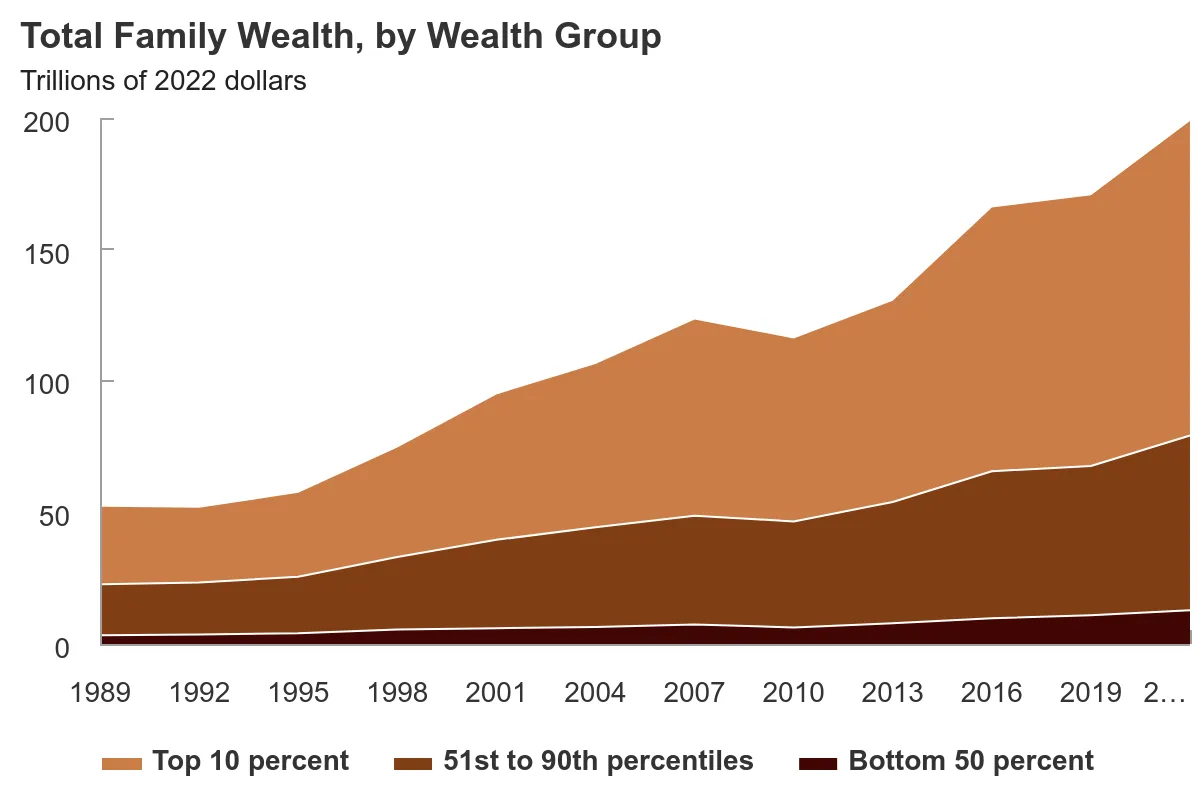
Wealth inequality is a trend that's continuing. Now that we have a weapon of mass greed, this chart will J-curve, too. Wealth can be wield as power.
One solution to this problem is the worst case scenario.
Safety with AI models is really hard, but really important. If we can make AI relatively safe to use, and prevent it from doing things on its own that are harmful, then we can rest easy and enjoy all the benefits. Right?
AI is software. You can learn how it works, there's open-weight models, there's open sourced training data, harnesses, and more. One potential solution to avoiding true dominance by any one particular company is having a truly open AI available to all, or even multiple open AIs for all.
But open-weight models are changeable. How do you make them universally safe? You fundamentally cannot.
You can change the fine-tuning of open-weight models, the safety guardrails. You can give it a dark bias and the imperative to act on it.